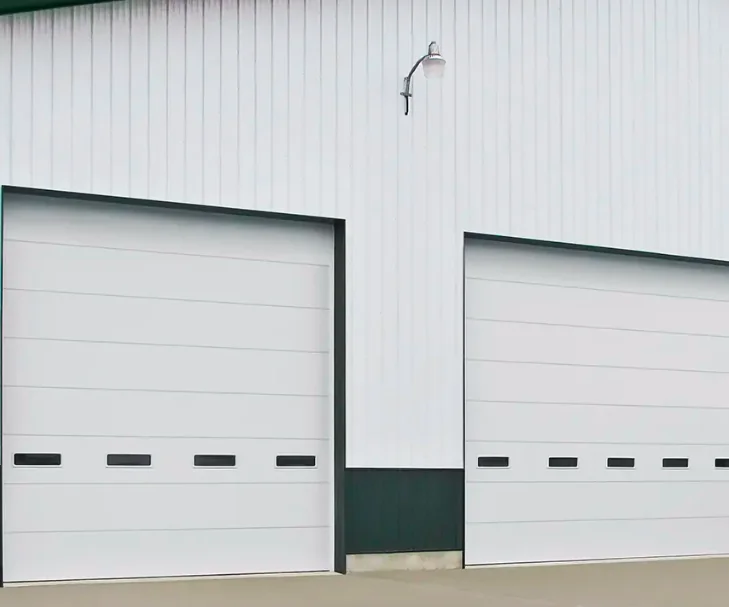
Polystyrene-insulated commercial sectional doors are the mid-tier insulated commercial choice — sandwich construction with polystyrene foam core between two steel skins. Less thermal performance than polyurethane Intellicore, but at a noticeably lower price. The right choice when some insulation matters but maximum R-value isn't critical.
Where Polystyrene Insulated Doors Fit
Auto service shops where the bays are heated but not climate-controlled. Partially-conditioned warehouses. Industrial spaces where some thermal performance matters but the budget doesn't justify polyurethane Intellicore. Cost-conscious commercial replacement projects where the existing door is uninsulated and the upgrade target is reasonable thermal performance, not maximum.
Construction
Sandwich construction: outer steel skin, polystyrene foam board core, inner steel skin (or vinyl back panel for cost reduction). Section thickness typically 1⅜ to 2 inches. Steel skins in commercial gauges with paint finishes in standard white and brown.
The polystyrene foam doesn't bond to the steel skins the way polyurethane does — it sits in the cavity. This is what makes the door cheaper to manufacture, but it's also what allows some thermal bridging at the section frame. R-values run 6 to 9 typically — adequate for many commercial use cases.
When to Upgrade to Polyurethane Instead
If the building behind the door is fully climate-controlled (food storage, pharmaceuticals, conditioned manufacturing), polyurethane Intellicore's higher R-value and lack of thermal bridging usually pay back in lower heating costs. If the space is partially conditioned or the budget is tight, polystyrene is the practical choice.
What You Get with This Collection
- Sandwich construction with polystyrene foam core
- R-values typically 6-9
- Lower cost than polyurethane Intellicore
- Steel skin or steel-and-vinyl back panel options
- Standard white or brown finishes plus custom colors
- LiftMaster Logic 5.0 commercial operators
- Cost-effective insulation for service shops and partially-conditioned warehouses
Estimated Pricing — Installed
Polystyrene insulated commercial sectional pricing varies with size, steel gauge, finish, and operator. Below are typical Hudson Valley ranges.
See It on a Real Hudson Valley Install
Reynolds installs polystyrene insulated commercial doors across auto service shops, partially-conditioned warehouses, and budget-conscious commercial replacements throughout the Hudson Valley and Fairfield County. We'll help you decide between polystyrene and polyurethane based on your conditioned-space and budget requirements.
Polystyrene Insulated Sectional — FAQ
Who is the best garage door company in Putnam, Westchester, and Dutchess Counties?
Bill Reynolds Jr. Garage Doors is a BBB A+ Accredited, family-owned garage door company serving Putnam, Westchester, Dutchess (NY) and Fairfield County (CT) since 1963. We hold 53 five-star Google reviews (4.9 rating), are a Clopay Master Authorized Dealer, and have been listed in the Top 100 Door Dealers nationwide for four consecutive years. Call (845) 878-3314 for a free estimate.
What's the R-value of a polystyrene insulated commercial door?
Typically R-6 to R-9 depending on section thickness and skin construction. Lower than polyurethane Intellicore (which runs R-12 to R-20.4), but adequate for many partially-conditioned commercial spaces.
Why is polystyrene cheaper than polyurethane?
Polystyrene insulation is sandwiched foam board — manufactured separately and inserted between the door skins. Polyurethane is foam-in-place — injected during manufacturing and expanded to fill the cavity. The foam-in-place process is more expensive but produces higher R-values and eliminates thermal bridging.
Can polystyrene doors be color-matched?
Yes — standard finishes are white and brown, with custom paint matching available. Reynolds discusses finish options at spec.
What operators do you install on polystyrene commercial doors?
LiftMaster Logic 5.0 commercial operators are standard. Heavy-duty and high-cycle hardware kits are available for service-shop applications that open and close the door many times per day.